

Most men don’t notice they’re losing hair until a significant amount is already gone. By the time a thinning crown becomes obvious in a mirror, or someone else points it out in a photo, the process has often been underway for years. The early warning signs are subtle, easy to rationalize, and simple to dismiss — until they’re not.
Recognizing what to look for early isn’t about vanity. It’s about having options. The sooner hair loss is identified and addressed, the broader the range of solutions available — and the better the long-term outcomes. This guide walks through the signs most men overlook, what they actually signal, and why acting early makes a measurable difference.
How Common Is This — Really?
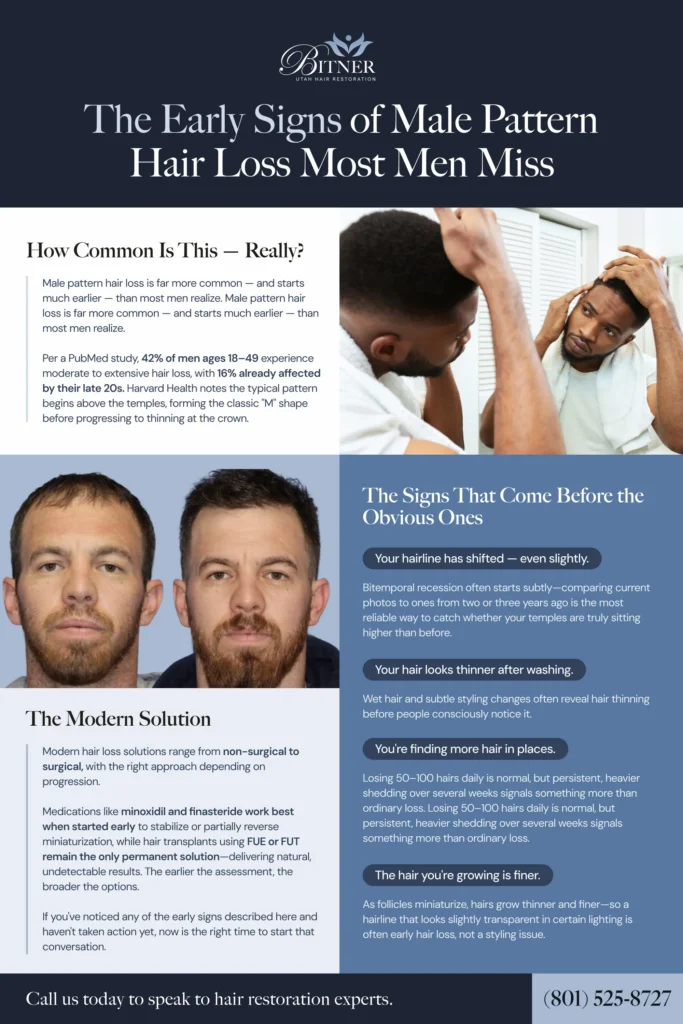
Before covering the early signs, it helps to understand just how widespread this condition is. According to a community-based study published through PubMed, 42% of men between the ages of 18 and 49 have moderate to extensive hair loss. Among men in the 18 to 29 age group, the figure is already at 16% — meaning male pattern hair loss is far from a condition that only surfaces in middle age. By the time men reach their 40s, more than half are affected.
That scale matters, because it means a significant portion of men in their 20s and early 30s are in the early stages of a progressive condition — and most of them have no idea it’s happening yet.
According to Harvard Health, in men, hair loss typically begins above the temples, with the receding hairline eventually forming a characteristic “M” shape, and hair at the top of the head thinning over time, often progressing toward baldness. That classic presentation starts with signals that are easy to overlook when you don’t know what you’re looking at.
The Signs That Come Before the Obvious Ones
Hair loss doesn’t announce itself dramatically. It’s gradual by design — follicles miniaturize slowly, hair shafts thin over time, and density loss is so incremental that it moves beneath conscious awareness for a long while. But there are specific early indicators worth knowing.
Your hairline has shifted — even slightly. The bitemporal recession that defines patterned loss typically begins with very minor movement at the temples. Most men chalk this up to their natural hairline shape or a style they’ve always had. Comparing a current photo to one taken two or three years ago is one of the most reliable ways to catch this shift early. If the temples are sitting higher or further back than they used to, that’s meaningful information — not a coincidence.
Your hair looks thinner after washing. Wet hair shows density more honestly than styled, dry hair. If your scalp is consistently more visible right after a shower than it used to be, that deserves attention. Many men unconsciously adjust their styling over time — slightly different partings, more product, brushing forward — to manage early thinning without realizing they’ve started doing it. These behavioral adaptations often precede conscious awareness by months or years.
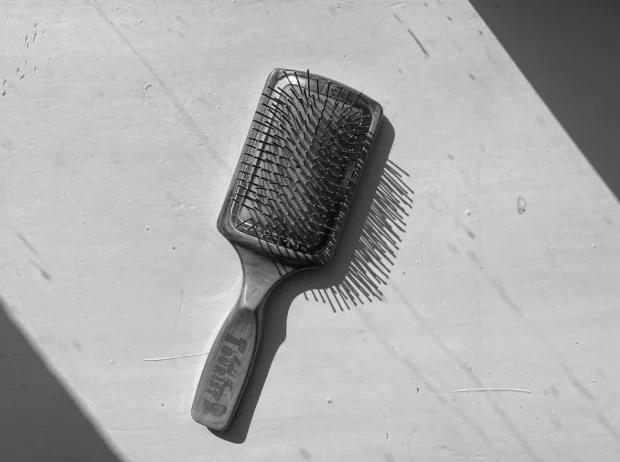
You’re finding more hair on your pillow, in the shower drain, or on your brush. Some daily shedding is normal — 50 to 100 hairs per day falls within the expected range. What changes with early androgenetic loss is the ratio of hairs that grow back versus those that don’t. Persistent, heavier-than-usual shedding over several weeks is a signal worth taking seriously rather than explaining away.
The hair you’re growing is finer than it used to be. This is the sign most men miss entirely. As follicles miniaturize, they produce progressively thinner, shorter, lighter strands. The total count of hairs may not drop sharply at first, but the individual strands become less substantial. A hairline that looks slightly transparent or fine in certain lighting is often showing early follicular miniaturization — not just a styling artifact.
Your part looks wider. A widening part — particularly at the crown or along the top of the scalp — is a consistently overlooked early indicator. If your natural part has widened measurably over the past year or two, the underlying cause is almost certainly follicular miniaturization in that zone, not a change in how you’re styling your hair.
Why Men Wait — and Why That Works Against Them
There’s a well-documented tendency for men to delay addressing hair loss, sometimes by years or even decades. Part of it is normalization — “it runs in the family, nothing can be done.” Part of it is the outdated association between hair restoration and the unnatural-looking results of earlier decades.
If you’ve heard about hair plugs Utah patients used to receive decades ago and assumed modern procedures look the same — that association deserves an update. The field has changed dramatically. What was once a visible, plug-based procedure is now a precise, artistic process that produces outcomes fully integrated with existing hair. The era of obvious, detectable results is long behind the industry’s best providers.
The real cost of waiting isn’t about vanity — it’s about shrinking options. Donor hair is a finite resource, and early intervention means more material to work with, more flexibility in hairline design, and more natural outcomes across the board.
What Modern Solutions Actually Look Like
The modern solutions available today span both non-surgical and surgical paths, and the right approach depends entirely on where someone is in the progression.
Non-surgical options — including FDA-approved medications like minoxidil and finasteride — are most effective when started early. They work to stabilize loss and, in some cases, partially reverse follicular miniaturization. Catching the condition early is what makes these options viable.
For men whose loss has progressed to the point where restoration is the goal, a hair transplant remains the only permanent solution available. Modern FUE and FUT techniques produce results that are virtually undetectable as procedures — grafts are placed at natural angles, hairlines are designed with long-term aging in mind, and the transplanted follicles are resistant to the hormonal sensitivity that drives pattern loss, meaning results are permanent.
The transformation from thinning to winning is different for every patient — but it consistently starts with an honest assessment while options are still broadest.
What to Expect From New Growth
One of the most important things men need to know before any restoration procedure is what the timeline for new growth actually looks like. The transplanted hairs shed in the first few weeks — this is normal and expected. Growth begins to emerge around months three to four, accelerates through months six to nine, and reaches full density within 12 to 18 months. Knowing that arc in advance makes the waiting period significantly easier to manage.
A provider who prepares patients for every stage of that timeline — not just the procedure itself — is one invested in the full experience, not just the clinical outcome.
Why Choosing the Right Provider Changes Everything
Not every clinic that offers hair restoration brings the same standard of care. Choosing a hair restoration center of Utah means holding a provider to a specific benchmark: comprehensive, honest, patient-first care that covers the full arc from initial assessment through long-term follow-up.
A quality provider conducts a thorough scalp and donor area evaluation before making any recommendations. They’re honest about what stage of loss you’re at, what progression might look like without intervention, and what outcomes are realistically achievable. They present all options — surgical and non-surgical — and let the patient lead the decision rather than steering toward whatever’s most convenient for the clinic.
That kind of transparency, from the very first conversation, is what separates a trustworthy provider from one simply offering a service.
Why Utah Patients Choose Utah Hair Restoration
Utah Hair Restoration brings the kind of honest, individualized assessment that sets the right tone from the very beginning. Whether you’re in the earliest stages of noticing subtle changes or further along and ready to explore full restoration, the team provides the clinical knowledge and genuine patient investment to help you make the right call for your specific situation.
From the first consultation through recovery and long-term results, the focus stays where it belongs — on your outcome, your timeline, and your goals. That’s what makes the difference between a provider worth trusting and one simply offering a procedure.
If you’ve noticed any of the early signs described here and haven’t taken action yet, now is the right time to start that conversation.
Ready to Take the First Step?
Call (801) 525-8727 to speak directly with our team and get clear, honest answers about where you stand and what your options look like.
Fill out our contact form and we’ll reach out to schedule your consultation at a time that works for your schedule.
Utah Hair Restoration is ready to help you move from questions to answers — and from answers to results.