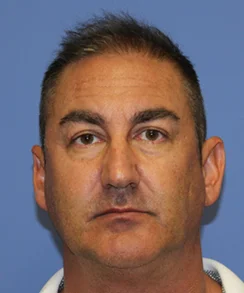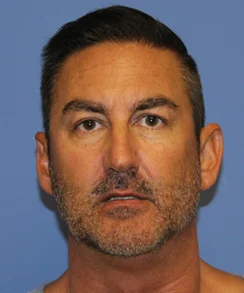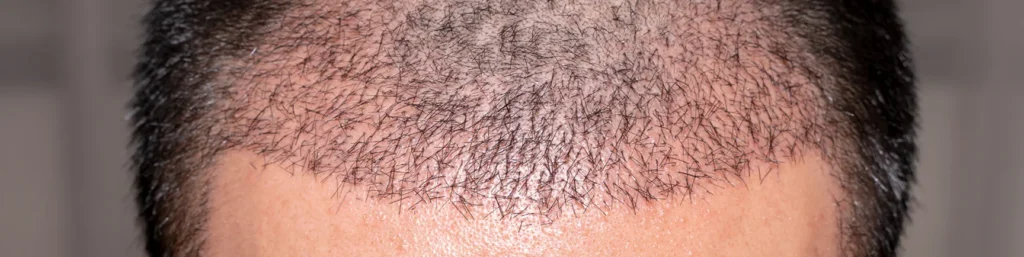
Hair replacement surgery for men — also called male pattern baldness surgery or surgical hair restoration — moves permanent, genetically resistant hair follicles from the back and sides of the scalp into areas thinned by male pattern baldness. Because the transplanted follicles keep their resistance to the hormones driving the loss, they grow for life. It is the only treatment that restores hair to areas where follicles have already stopped producing — medications can slow or partially reverse thinning, but they cannot rebuild a hairline that’s gone.
At Utah Hair Restoration in Layton, every procedure is performed personally by Dr. John Bitner, MD, PhD, a board-certified facial plastic and reconstructive surgeon and the only physician in Utah fellowship-trained in both facial plastic surgery and hair transplantation surgery. That combination matters for men specifically: a male hairline is a facial aesthetic structure, and designing one that suits your face today — and at 60 — is as much surgical artistry as it is technique.
Why Men Consider Surgical Hair Replacement
Pattern hair loss affects a majority of men over their lifetime, typically beginning with hairline recession at the temples, thinning at the crown, or both — a progression documented in the National Library of Medicine’s overview of androgenetic alopecia. For many men, the decision point isn’t vanity; it’s the gap between how they feel and what the mirror shows. Surgery is worth considering when:
- Loss has progressed beyond what non-surgical treatments can meaningfully recover
- The hairline or crown loss is stable enough to plan around
- You want a permanent, low-maintenance result rather than daily concealment
- You have adequate donor hair — which Dr. Bitner measures directly at consultation
Surgery is not the first answer for every man. Early-stage loss is often best addressed by stabilizing it medically first, sometimes with surgery planned as a second phase. Dr. Bitner will tell you plainly which camp you’re in — including if the honest answer is “not yet.” Start with Am I a Good Candidate?
Your Two Surgical Options: FUE and FUT
Male pattern baldness surgery at Utah Hair Restoration uses one of two harvesting techniques — or a combination:
FUE (Follicular Unit Extraction). Grafts are removed individually with sub-1mm punches. No linear scar, ideal for men who wear their hair short.
FUT (Follicular Unit Transplantation / strip method). A narrow donor strip is dissected into grafts. Largest single-session graft counts — typically 2,000+ in a large session — making it the efficient choice for advanced loss.
Because Dr. Bitner performs both, the technique recommendation follows your case rather than a clinic’s single offering. See the full FUE vs. FUT comparison for the trade-offs.
What Makes a Male Hair Replacement Result Look Natural
Three surgical decisions separate an undetectable result from an obvious one:
- Hairline design. A natural male hairline is irregular, slightly asymmetric, and positioned for your age and facial proportions — not drawn as a straight line. Dr. Bitner designs the frontal hairline with single-hair grafts in a soft transition zone, avoiding the “wall of hair” look.
- Angle and direction. Every graft is implanted at the angle and direction of your original growth pattern, so restored hair combs, parts, and moves like it always did.
- Donor-supply planning. Hair loss keeps progressing after surgery. A responsible plan budgets your finite donor supply across the loss you’ll experience over decades — sometimes staging restoration across sessions 6–12 months apart.
The Process, Cost, and Recovery
Your consultation produces a written treatment plan and estimate. Surgery is performed in the practice’s private, in-office surgical suite under local anesthesia (sedation available), with only one patient scheduled per day — the full sequence is on our Day of Surgery page. Most men are back at desk work within 2–5 days depending on technique. Transplanted hair sheds at 2–4 weeks, regrows from months 3–4, and matures over 12–18 months; see the recovery page and the month-by-month results timeline.
Utah Hair Restoration publishes session-based pricing openly — including graft-count commitments in writing for large sessions — on the hair transplant cost page, along with financing options. Results from real patients are in the photo gallery, including broadcaster Alema Harrington’s restoration.
Hair Replacement Surgery for Men — FAQs
What is the best hair replacement surgery for men?
The best surgery is the technique matched to your pattern of loss, donor supply, and hairstyle. FUE suits men who wear their hair short and need targeted work; FUT suits men with advanced loss who need maximum grafts per session. A surgeon trained in both — rather than a clinic selling one method — should make that call with you.
At what age should a man get hair replacement surgery?
There’s no fixed age, but pattern and stability matter more than the calendar. Men in their 20s with rapidly progressing loss are often advised to stabilize medically first, while men 30+ with defined patterns are frequently strong candidates. Dr. Bitner evaluates progression, family history, and donor supply before recommending timing.
Is male pattern baldness surgery permanent?
Yes — transplanted follicles come from the donor zone that’s genetically resistant to pattern loss, so they keep growing for life. Native, non-transplanted hair can continue thinning, which is why long-term planning (and sometimes ongoing medical therapy) is part of the treatment plan.
How much does hair replacement surgery for men cost?
FUT sessions are priced by session size and FUE per graft, with a written estimate at consultation. Full current pricing and financing options are published on our cost page.
Will people be able to tell I had surgery?
Once grown in, a properly executed restoration is undetectable — grafts follow your natural angles and the hairline uses single-hair transitions. During the first 1–2 weeks there are visible signs of the procedure (small scabs, redness), which most men plan around with remote work or time off.
Do I still need hair loss medication after surgery?
Often, yes — surgery restores lost areas, while medical therapy helps protect the native hair you still have. Dr. Bitner discusses whether non-surgical treatment belongs in your long-term plan at consultation.
Get a straightforward surgical opinion on your hair loss — including whether surgery is right for you yet. Call (801) 525-8727 or request a consultation with Dr. Bitner at Utah Hair Restoration in Layton, Utah.