

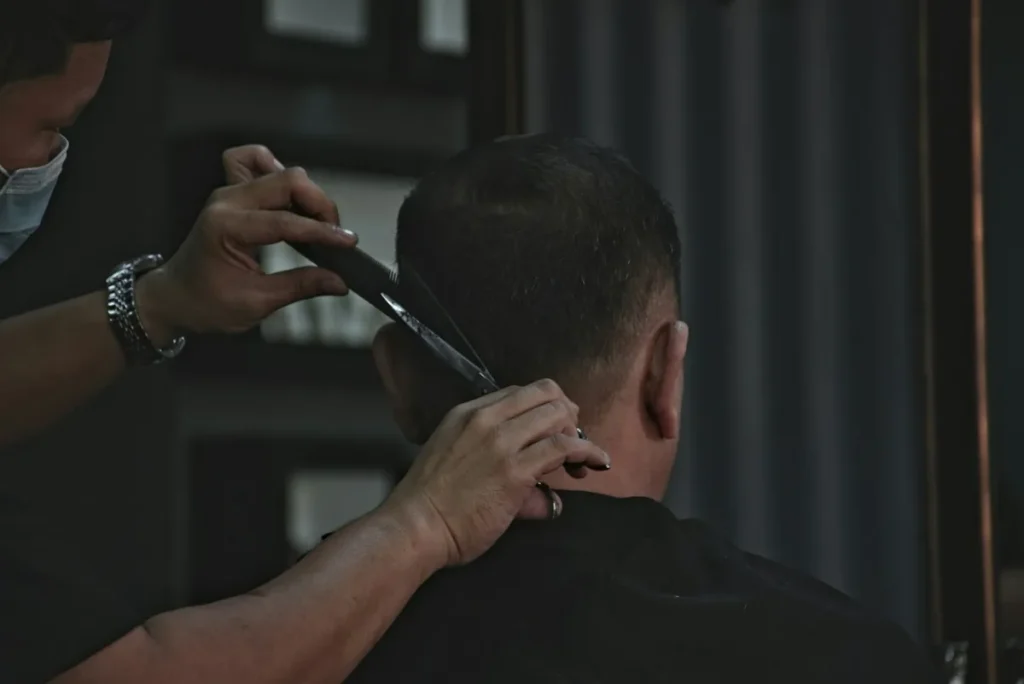
For a lot of men considering hair restoration, one question quietly outranks all the others: will I still be able to cut my hair short? It’s a fair question. A transplant that forces you into longer hairstyles to hide its own evidence has traded one self-consciousness for another. The answer depends almost entirely on how your donor hair is harvested — which is why the FUE hair transplant scar question deserves a straight, detailed answer before you choose a technique.
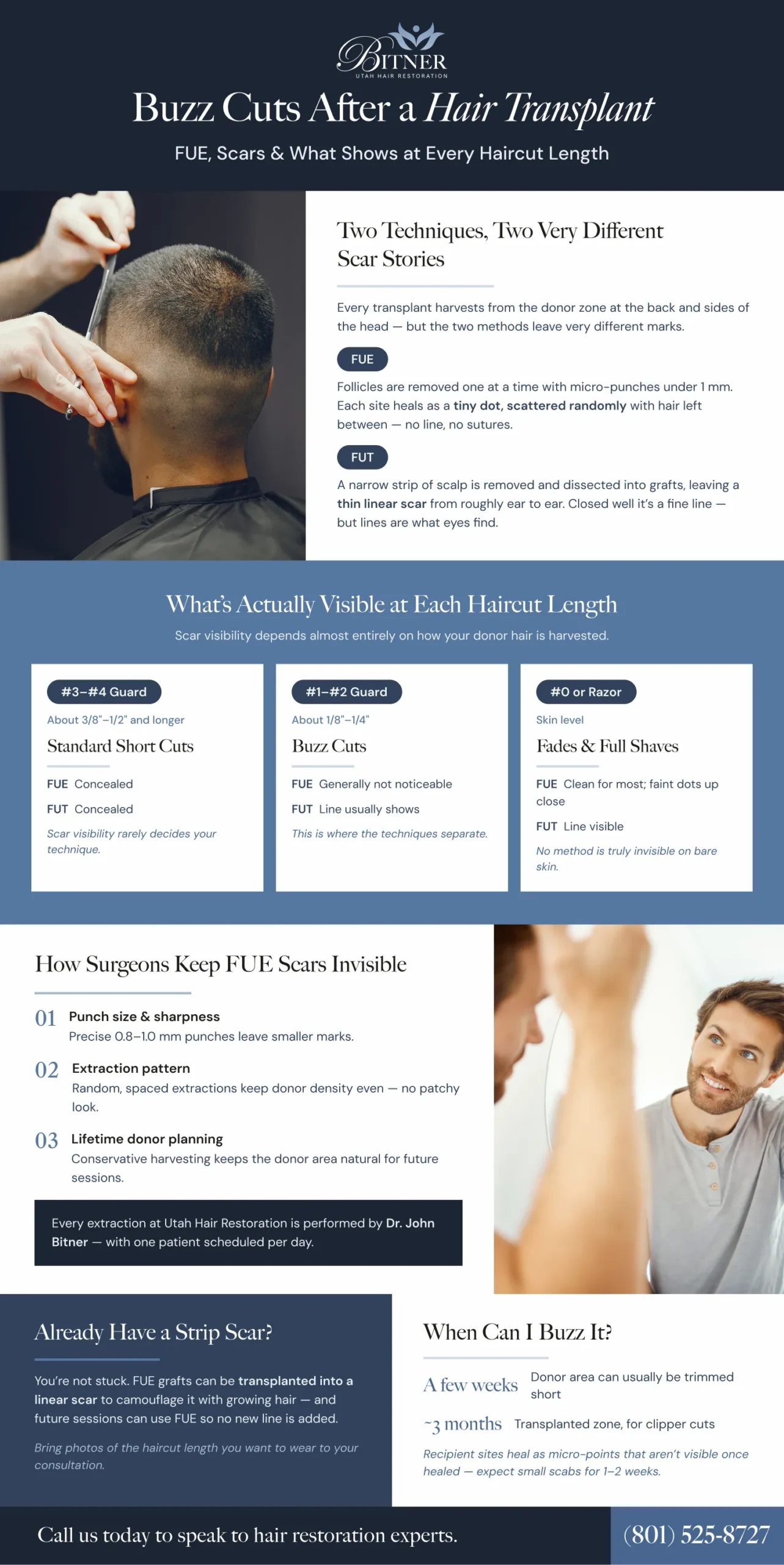
Two Techniques, Two Very Different Scar Stories
Every hair transplant moves follicles from the permanent donor zone at the back and sides of your head. The two harvesting methods leave very different marks behind.
FUE (Follicular Unit Extraction) removes follicular units one at a time through micro-punches under 1 millimeter across. Each extraction site heals as a tiny round dot, scattered randomly through the donor zone with healthy hair left between them. There is no line, no sutures, and no single feature for the eye to catch.
FUT (Follicular Unit Transplantation), the strip method, removes a narrow band of scalp that is dissected into grafts, leaving a thin linear scar from roughly ear to ear. Closed well, it heals as a fine line — but it is a line, and lines are what eyes find. The full trade-off between the methods is laid out in our FUE vs. FUT comparison.
What’s Actually Visible at Each Haircut Length
Here’s the practical breakdown most articles skip:
- Standard short cuts (#3–#4 guard, about 3/8″–1/2″, and longer). Both FUE dots and a well-healed FUT line are concealed. If you wear your hair at these lengths, scar visibility rarely decides your technique.
- Buzz cuts (#1–#2 guard, about 1/8″–1/4″). This is where the techniques separate. FUE dot scars are generally not noticeable at these lengths for most patients; a FUT line usually shows.
- Skin fades and full head shaves (#0 or razor). No harvesting method is truly invisible on shaved skin. Most FUE patients still look clean at very short lengths, but some — depending on skin tone, healing characteristics, and how many grafts were taken — will show faint dotting on close inspection. Anyone promising a completely undetectable shaved head regardless of technique is overselling.
That last point matters, because honest expectation-setting is part of good surgery. As the National Library of Medicine notes in its overview of hair loss treatments, hair transplantation is a surgical procedure — and every surgical procedure involves healing skin. The goal of modern technique isn’t “no healing marks exist”; it’s “no one can find them in real life.”
How Surgeons Keep FUE Scars Invisible
Scar outcome isn’t just the technique — it’s how the technique is executed. Three factors do most of the work:
- Punch size and sharpness. Smaller, precise punches (0.8–1.0 mm) leave smaller marks. This is standard equipment at Utah Hair Restoration.
- Extraction pattern. Scattering extractions randomly and leaving hair between harvested units keeps the donor zone’s density visually even. Over-harvesting one area — a hallmark of high-volume clinic chains — creates the patchy, moth-eaten donor look that reads as “had work done” even without a linear scar.
- Lifetime donor planning. Your donor zone is finite. A surgeon planning for your whole pattern-loss trajectory harvests conservatively so the donor area still looks natural after a second or third session decades later.
At Utah Hair Restoration, every extraction is performed by Dr. John Bitner — a board-certified facial plastic and reconstructive surgeon, fellowship-trained in hair transplantation surgery — with one patient scheduled per day. Guidance from the International Society of Hair Restoration Surgery makes the same point from the professional side: who performs your surgery, and how much of it they personally perform, is a question worth asking any clinic directly.
Already Have a Strip Scar? You Have Options
Men who had a FUT procedure years ago and now want shorter hair aren’t stuck. FUE grafts can be transplanted into a linear scar to camouflage it with growing hair, and future sessions can use FUE so no new line is added. If you’re in this situation, it’s a routine conversation at a consultation — bring photos of the haircut length you want to wear.
What About the Transplanted Area?
The recipient zone — where grafts are placed — heals as micro-points that are not visible once healed, regardless of technique. During the first week or two you’ll have small scabs at each graft site (the healing arc is mapped on our results timeline), and after that, the only thing visible up front is hair.
Buzz Cuts and FUE Scars: FAQs
Can you see FUE scars with a buzz cut?
At typical buzz lengths (#1–#2 guard), FUE extraction dots are generally not noticeable for most patients. At skin-level shaves, some patients show faint dotting on close inspection. If very short hair is your goal, say so at consultation — it shapes punch size, graft counts, and extraction pattern.
Can I shave my head completely after FUE?
You can, and many patients look clean shaved. But no harvesting method is guaranteed invisible on bare skin — skin tone and individual healing vary. An honest surgeon will show you donor-area photos of prior patients at the length you want.
How long after a hair transplant can I get a buzz cut?
The donor area can usually be trimmed short within a few weeks. For the transplanted zone, most surgeons advise waiting until grafts are fully established — commonly around 3 months for clipper cuts, with specifics set in your recovery instructions.
Do FUE scars get worse over time?
FUE dots are stable once healed. This differs from strip scars, which can widen over years in some patients depending on scalp tension and skin characteristics — one reason short-hair wearers are steered toward FUE from the start.
Is FUE always better than FUT then?
No — FUT still moves more grafts per session and uses donor supply efficiently for larger restorations, which is why both techniques exist. If you never wear your hair shorter than a #3, the linear scar may be irrelevant to you. The comparison page walks through when each wins.
Want to know what your donor zone can support — and what it will look like at the haircut length you actually wear? Call (801) 525-8727 or schedule a consultation with Dr. Bitner at Utah Hair Restoration in Layton, Utah.